

ContentsTap to jump to a section+
A new alternative to a long-lived Anthropic key
Windmill released1.849.0 on October 25, 2026, adding Anthropic Workload Identity Federation for Windmill AI chat and copilot. Instead of retaining an Anthropic API key in a resource, the server can exchange a short-lived user assertion for an access token. The feature requires Windmill’s Enterprise OIDC provider; it is not automatically available in every Community Edition deployment.
Scripts and AI agent workflow steps cannot use the new resource type. Operators replacing keys in unattended jobs must not assume that selecting anthropic_federated makes those execution paths supported.
Per-user identity, a shared service account
Windmill’s implementation mints an OIDC assertion for the requesting user. OIDC carries signed identity information that another system can verify. The described assertion includes the user and workspace identity, targets Anthropic and has a30-minute lifetime.
The server exchanges the assertion at Anthropic’s token endpoint and uses the resulting short-lived access token. Its cache is separated by workspace, federation settings and user email, rather than passing one user’s cached token to another.
Each exchange nevertheless acts through the Anthropic service account configured in the federation rule. Usage is billed to that account, not automatically to separate employee accounts. Distinguish audit identity from billing ownership and spending controls.
Removing an API key does not remove all secrets
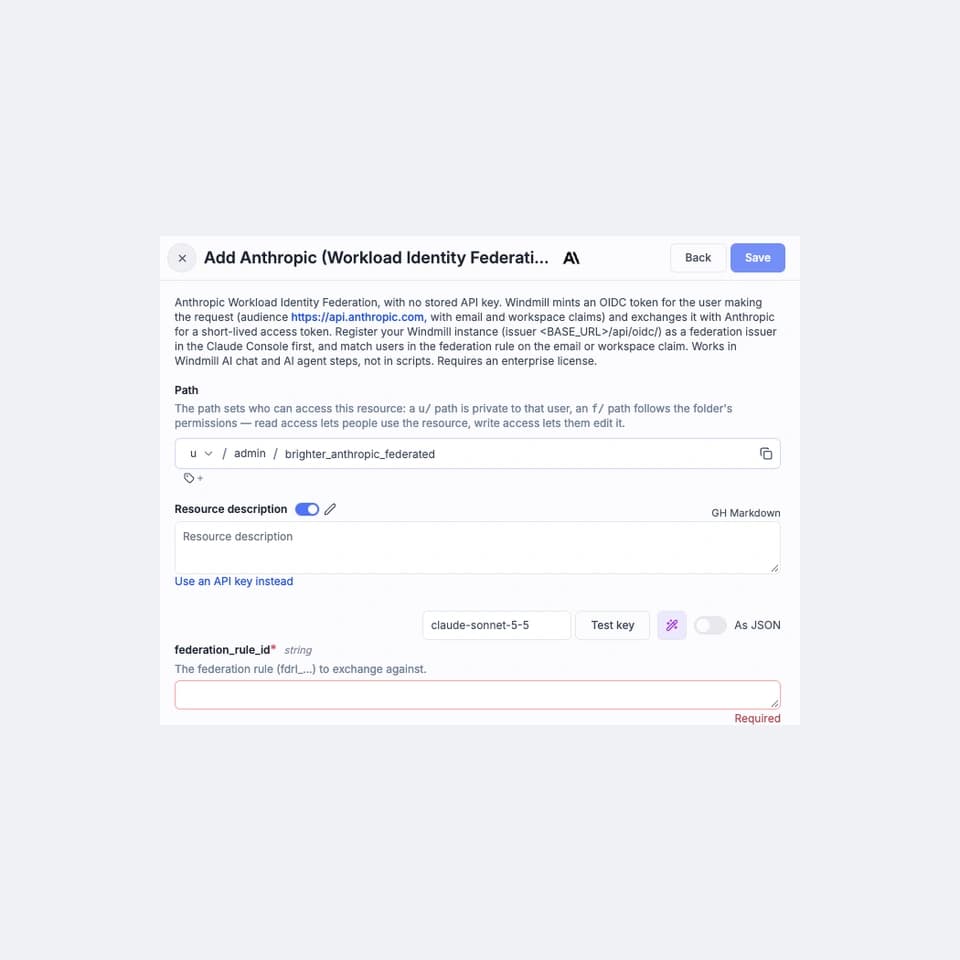
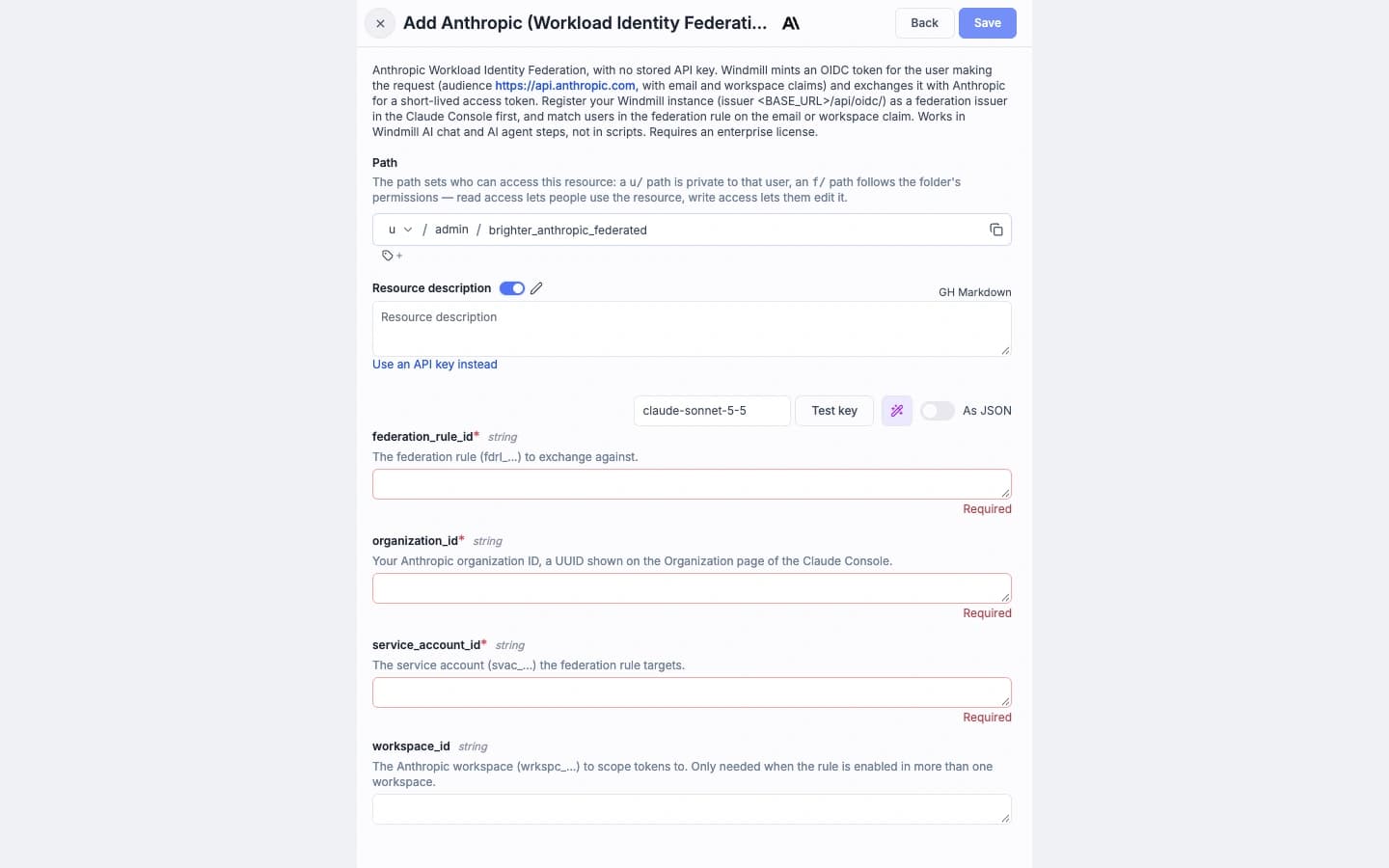
The resource needs the federation rule, organization and service-account identifiers, with an optional Anthropic workspace. Anthropic must trust the intended issuer and restrict who may federate. Entering a resource name alone does not establish that trust relationship.
Windmill still needs to protect its OIDC signing material and administration settings. Short-lived access tokens remain sensitive while valid. Friday Works recommends controlling who can edit rules, handling personal identity information in logs appropriately and defining access-removal procedures.
The resource targets Anthropic’s endpoint rather than allowing an arbitrary base URL. The design explanation says this prevents a resource author from directing another user’s identity assertion or cached token to a host they control.
The Hub description visible in the capture also mentions AI agent steps. This report follows the reviewed 1.849.0 implementation rather than using live Hub text to establish support for that release. A configuration form visible in CE does not mean CE can perform the Enterprise token exchange.
Check edition and execution-path support first
The deployment needs the new Windmill version, the appropriate Enterprise OIDC capability and a configured Anthropic organization. Create the anthropic_federated resource and select it for Anthropic in Windmill AI. Standard API-key-based Anthropic resources remain a separate type.
Do not insert the resource into scripts or AI agent steps that expect a standard Anthropic resource. The change adds an explicit unsupported-path error rather than making federation universal across the platform.
Community Edition distribution and commercial-use terms have separate restrictions. Anyone considering a managed service for clients should review Windmill’s licence and agreements rather than treating public source as unrestricted permission to resell all packaged capabilities.
Trial two users before removing an existing key
Friday Works suggests a chat-only test with two staff accounts. Verify an allowed identity can federate, an excluded identity is denied, authentication history identifies the correct user and cached tokens are not mixed during concurrent use.
Then check refresh, expiry, access removal and service-account cost attribution. Migrate only supported paths after collecting evidence and retaining a tested fallback. These are proposed acceptance checks, not customer deployment results.
The images show the actual new resource configuration in an isolated Windmill 1.849.0 instance. They do not establish Enterprise activation or a successful Anthropic token exchange. The upstream change itself distinguishes testing request shape from successful federation with a real organization.
Next steps
Friday Works recommends testing against a copy and keeping evidence before changing a customer-facing system.
References
Sources used in this guide
We prioritise official guidance and primary technical sources. Visit each source for full context and the latest updates.
- Windmill 1.849.0, released October 25, 2026Windmill Labs ↗︎
- Per-user federation design, scope, licence requirement and upstream test limitationsWindmill Labs ↗︎
- Licences for source, Enterprise features and the packaged Community EditionWindmill Labs ↗︎
- Original capture of official CE 1.849.0 configuration form, October 26, 2026; official Hub schema, blank identifiers, no EE activation or exchange. Crop/resize/neutral margins only. Frontend AGPL-3.0; separate EE conditions. Hub description is not versioned runtime evidence.Friday Works / Windmill Labs ↗︎