

ContentsTap to jump to a section+
- The change clarifies crawling requirements
- Language redirects deserve inspection
- Favicon scope follows the hostname
The change clarifies crawling requirements
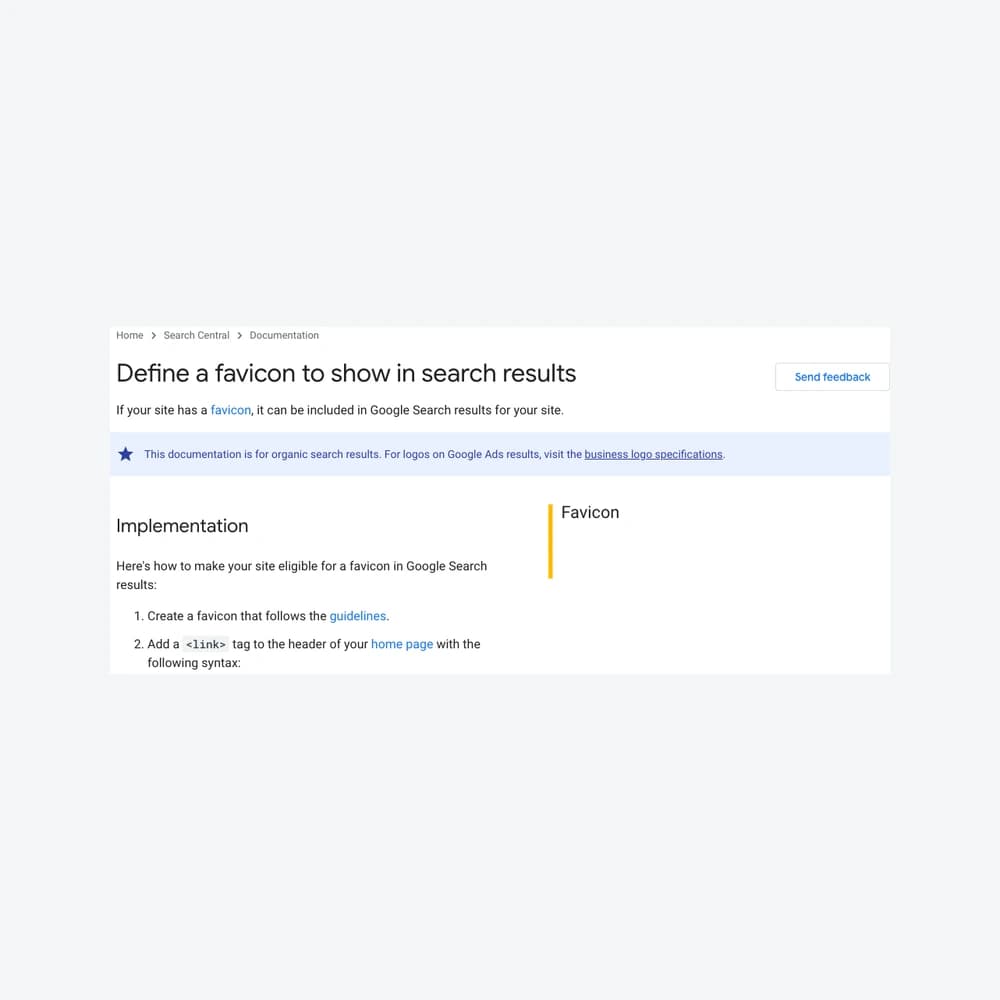
Google Search Central's favicon documentation, marked updated on 27 October 2026 UTC and reported by the SEO community on 28 October, clarifies crawling the homepage through redirects to the page declaring the favicon. Sites missing an icon should inspect that path before repeatedly replacing the image.
Googlebot must access the homepage, and Googlebot-Image must retrieve the favicon. Robots rules, bot protection and other access controls can obstruct that process. This is documentation clarification, not a ranking-algorithm announcement. Published on 30 October, this article explicitly extends the source window to 27 October. Its images show genuine Search Central documentation, not Search Console or proof that Google has refreshed a particular website.
Language redirects deserve inspection
A site redirecting its root to /vi or /en should ensure crawlers can follow the legitimate chain. Success in an administrator's cookie-bearing browser does not establish equivalent access for an unauthenticated crawler.
A homepage might declare its icon only after a redirect while a CDN permits continuation only with browser-session state. Inspect responses and destinations without logging in, then check the final HTML declaration. This is an evaluation scenario, not a claim that multilingual sites or CDNs are inherently faulty. Avoid disabling protection site-wide merely to fix an icon.
Favicon scope follows the hostname
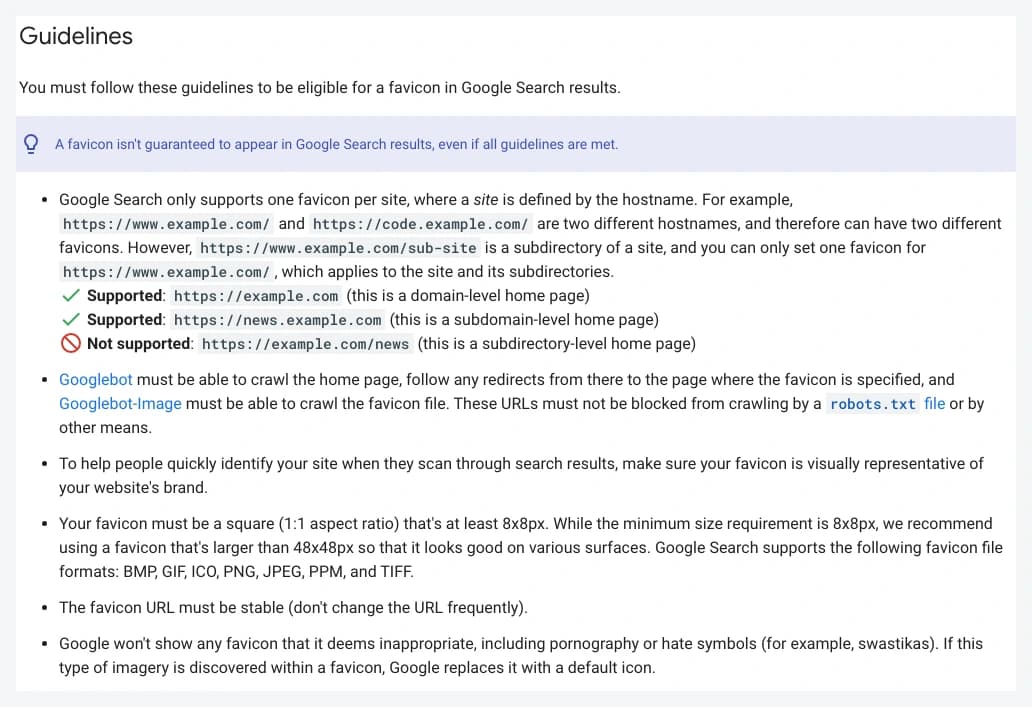
Google documents one favicon per hostname. /vi and /en under the same hostname do not automatically receive independent search favicons. A subdomain can be a different scope; a directory is not a subdomain.
The declaration can use relative or absolute URLs, including an image hosted elsewhere. Inspect both the declaring homepage and the image host, including the image's own redirects. Keep the favicon URL stable and record the actual declaration, response status and test time. Repeated filename changes complicate diagnosis when access remains the real problem.
Valid dimensions do not guarantee display
The current documentation requires a square favicon at least 8 by 8 pixels and recommends dimensions larger than 48 by 48 for different surfaces. The icon should represent the site and remain recognizable at small sizes.
Meeting the guidelines does not guarantee display. Separate crawlability, file validity and Google's display decision. A changed browser-tab icon is not evidence that Google Search has refreshed it. Organic-result favicons also differ from advertising brand logos; use the documentation for the surface actually affected.
Track the fix without confusing it with ranking gains
After fixing access or declarations, administrators can request homepage recrawling through URL Inspection as Google describes. Processing can take days to weeks; submitting a request guarantees no immediate refresh.
Retain before-and-after redirect, HTML and image-access evidence with dates. Track the same hostname while keeping Search Console impressions, clicks and positions separate. Correct favicon handling supports recognition but does not establish ranking or customer growth. Search outcomes require actual measurements and a comparable reporting period.
Further implementation reading
Friday Works provides implementation information and evaluation steps for business systems.
References
Sources used in this guide
We prioritise official guidance and primary technical sources. Visit each source for full context and the latest updates.
- Define a favicon: page marked Last updated 2026-10-27 UTC; crawl and redirect guidelinesGoogle Search Central ↗︎
- 28 October SEO reporting: documentation clarification, not a new ranking announcementSearch Engine Roundtable ↗︎
- Images: original Friday Works captures of the actual Search Central document, 29 October for cover and 30 October for Guidelines; document, not application UI; cropped to relevant content, proportionally resized and neutral marginsGoogle / Friday Works ↗︎
- Documentation content licence: Creative Commons Attribution 4.0; code samples have separate Apache 2.0 terms; marks excludedGoogle Developers ↗︎
- CC BY 4.0 licence; attribution Google, changes described above, no endorsementCreative Commons ↗︎