

ContentsTap to jump to a section+
- AWS announces 14 additional voices across nine locales, including Hindi and Finnish.
- Naturalness and latency improvements are vendor descriptions, not independent measurements here.
- The announcement does not establish Vietnamese support; check the required language and region.
A new upgrade for text-to-speech applications
AWS announced an Amazon Polly Generative engine upgrade on October 20, 2026, adding 14 voices across nine locales and bringing Hindi and Finnish to the engine. Multilingual training, information assistants and contact-center teams have additional options to evaluate. This does not establish a new Vietnamese voice.
Polly converts text into audio; Generative is a distinct engine within the service. AWS describes more natural speech, improved pronunciation and low latency. No independent benchmark or customer-data listening test was performed for this report.
Check the voice, locale and service region
The examples span US and Australian English, Hindi/Indian English, German, US Spanish, Brazilian Portuguese, Korean and Finnish. Locales include regional distinctions; nine locales are not nine entirely new languages. The announcement’s named examples do not enumerate all 14 voices, so no missing names are invented here.
Singapore is among the listed regions. Verify the actual voice ID, engine, locale and feature compatibility used by your application rather than assuming regional availability covers every configuration.
The Generative documentation warns that model or training updates can subtly change a voice even when overall quality improves. Compare newly synthesized segments with older content in long-running courses or audio series.
Review SSML and input content
AWS says existing Generative applications retain SSML compatibility. SSML marks up speech, but this does not imply every tag behaves identically across engines. Friday Works suggests a regression set covering names, amounts, dates, abbreviations and the tags actually used.
An English–Hindi workflow can compare the same approved script across old and new voices, recording pronunciation errors and response time. Use sample content rather than personal customer records. API access, processing location and usage-based cost still need review; the upgrade is not a blanket free-use announcement.
Run a small listening trial before bulk replacement
Friday Works recommends a small approved listening set with consistent scripts and acceptance criteria. Record meaning-changing errors, product-name clarity, generation time and failure handling as well as perceived naturalness. Obtain content-owner acceptance and a cost estimate before bulk conversion.
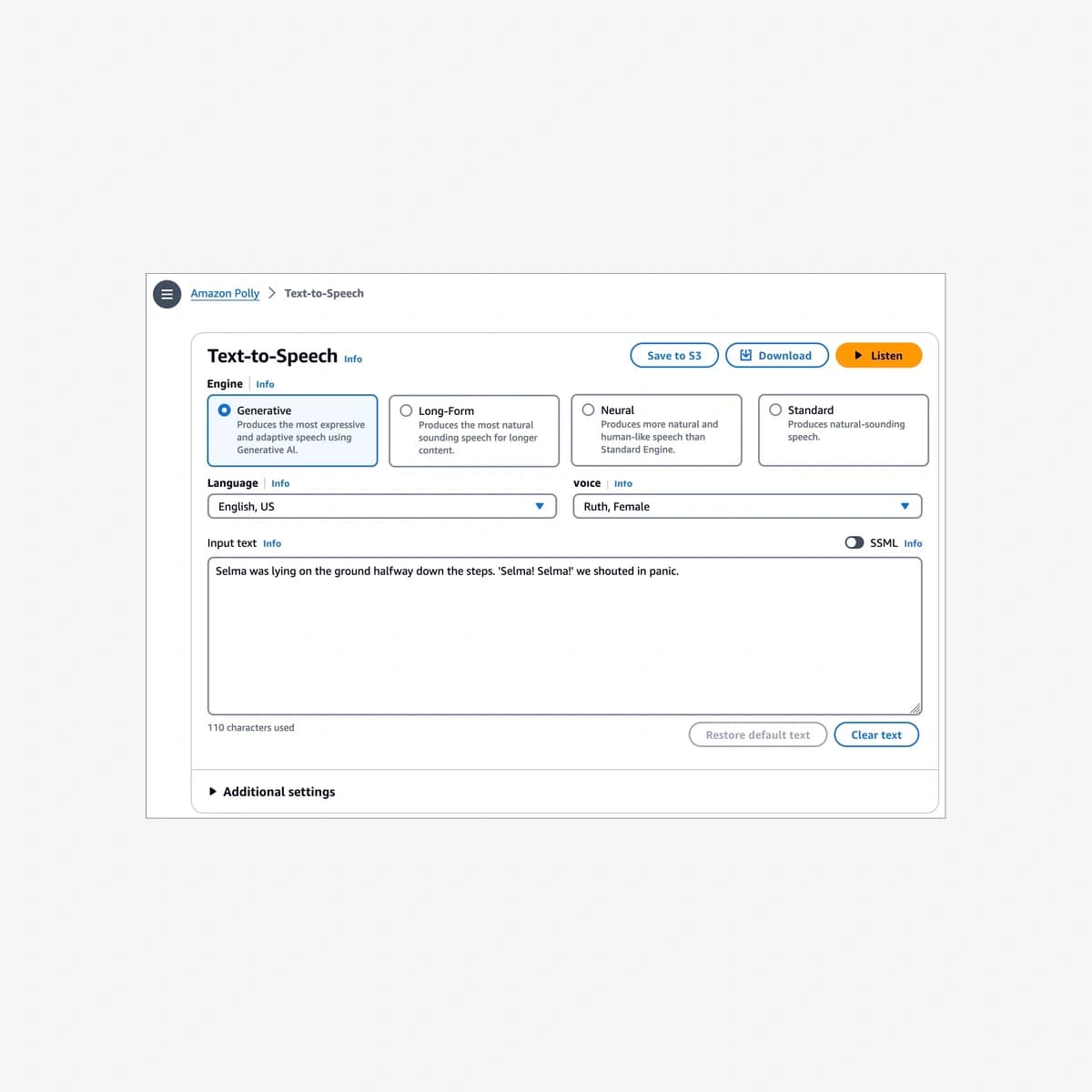
The cover is AWS’s actual May 8, 2024 Polly Text-to-Speech Generative demonstration with Ruth and English US. The original instructions use N. Virginia; the screenshot is not relabeled Singapore or presented as the 14 new voices.
The copyrighted Channy Yun/AWS image is used for limited educational product explanation under AWS Trademark Guidelines section 15, not claimed as Creative Commons material. Its archival date is separate from the October 20 announcement and it is not a test result.
References
Sources used in this guide
We prioritise official guidance and primary technical sources. Visit each source for full context and the latest updates.
- Polly Generative upgraded — 20 October 2026Amazon Web Services ↗︎
- Generative voices — availability, feature compatibility and model-update variation; maintained backgroundAmazon Polly documentation ↗︎
- Amazon Polly Generative console — Channy Yun, 8 May 2024, © AWS; limited educational screenshot, resized/framed onlyAWS News Blog ↗︎
- AWS Trademark Guidelines section 15: limited educational use; no general or open license claimedAmazon Web Services ↗︎