

ContentsTap to jump to a section+
- Price outcomes and acceptance cases rather than screen counts alone.
- Assign ownership for legacy data, exceptions and operations.
- Approve scope, schedule and cost effects before implementing a change.
A short requirement can hide substantial scope
Order management may include approvals, permissions, editing, refunds and reporting. Quotes using the same label can describe different deliverables.
Friday Works uses illustrative cases here, not market-price or delivery-time promises. A real budget requires agreed workflows, data and operating conditions.
Write executable acceptance cases
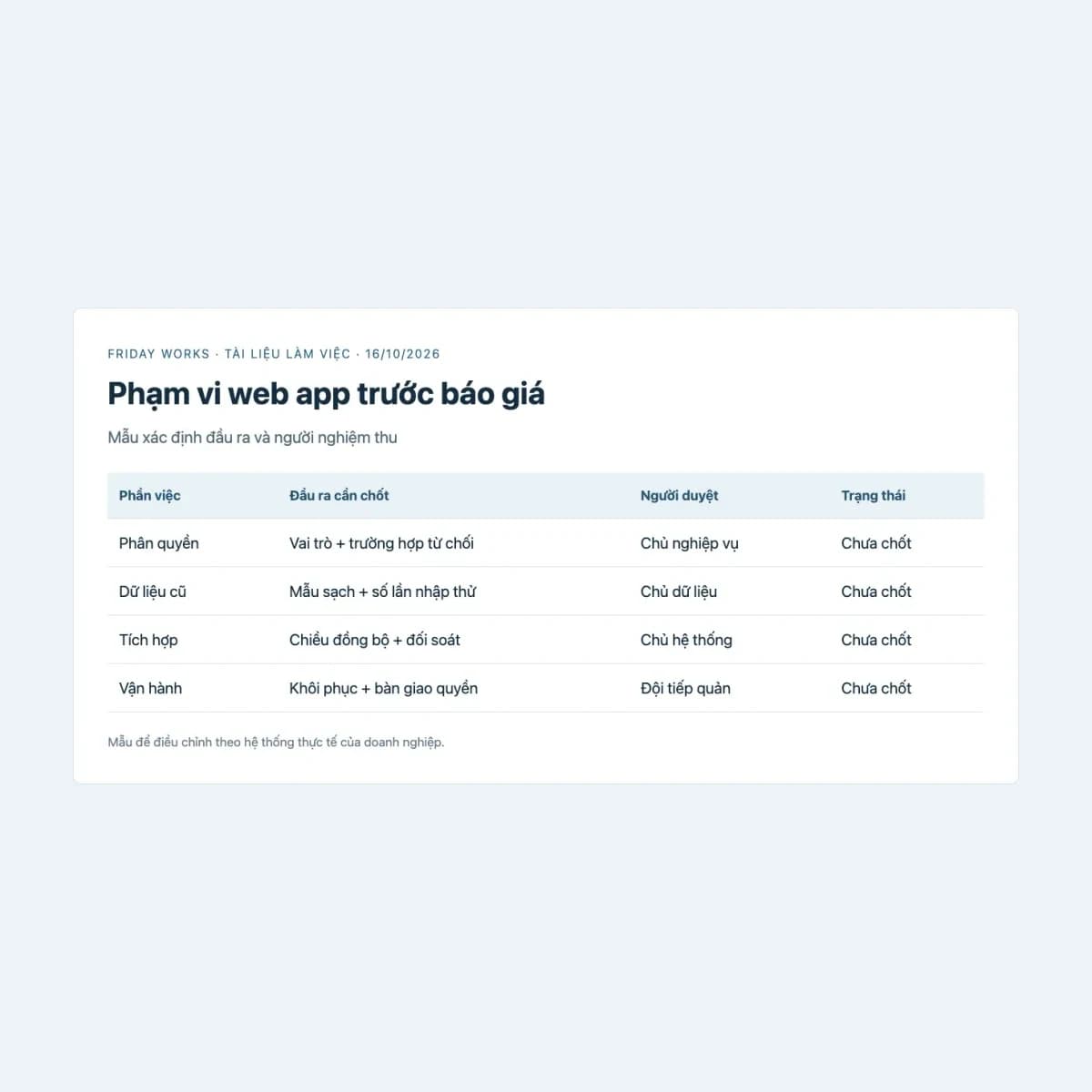
Specify which role can create, approve and reconcile which records. Give each case inputs, actions, an expected result and an acceptance owner. Include denial cases.
For example, a user denied access to another team’s order must also be denied through a direct URL. OWASP’s request-level authorization guidance can become an observable handover check.
Scope data and integrations explicitly
Identify data cleanup, duplicate handling, trial imports and ownership. State uncertainty when representative data is unavailable.
For integrations, define direction, fields, timing, provider limits and reconciliation. A successful demonstration does not establish recovery after a provider outage.
Budget for operating the system
Agree account administration, error handling, backup, restore checks and support boundaries. Document resource ownership and the recipient of administrative access.
Demonstrate a supervised operational task in a test environment. Delivering source files alone does not prove the receiving team can operate the system.
Approve the consequences of changes
Friday Works recommends recording the new need, affected work and options: reprioritize, defer or extend the budget. Obtain approval before implementation.
Compare included acceptance cases, exclusions and operating conditions alongside price. Budget control depends on agreed outcomes and a shared change process.
References
Sources used in this guide
We prioritise official guidance and primary technical sources. Visit each source for full context and the latest updates.