

ContentsTap to jump to a section+
- The audience includes product, program and business-analysis roles.
- The study guide covers tools, workflows and human oversight.
- A credential does not replace evidence of business value.
A new credential for workflow owners
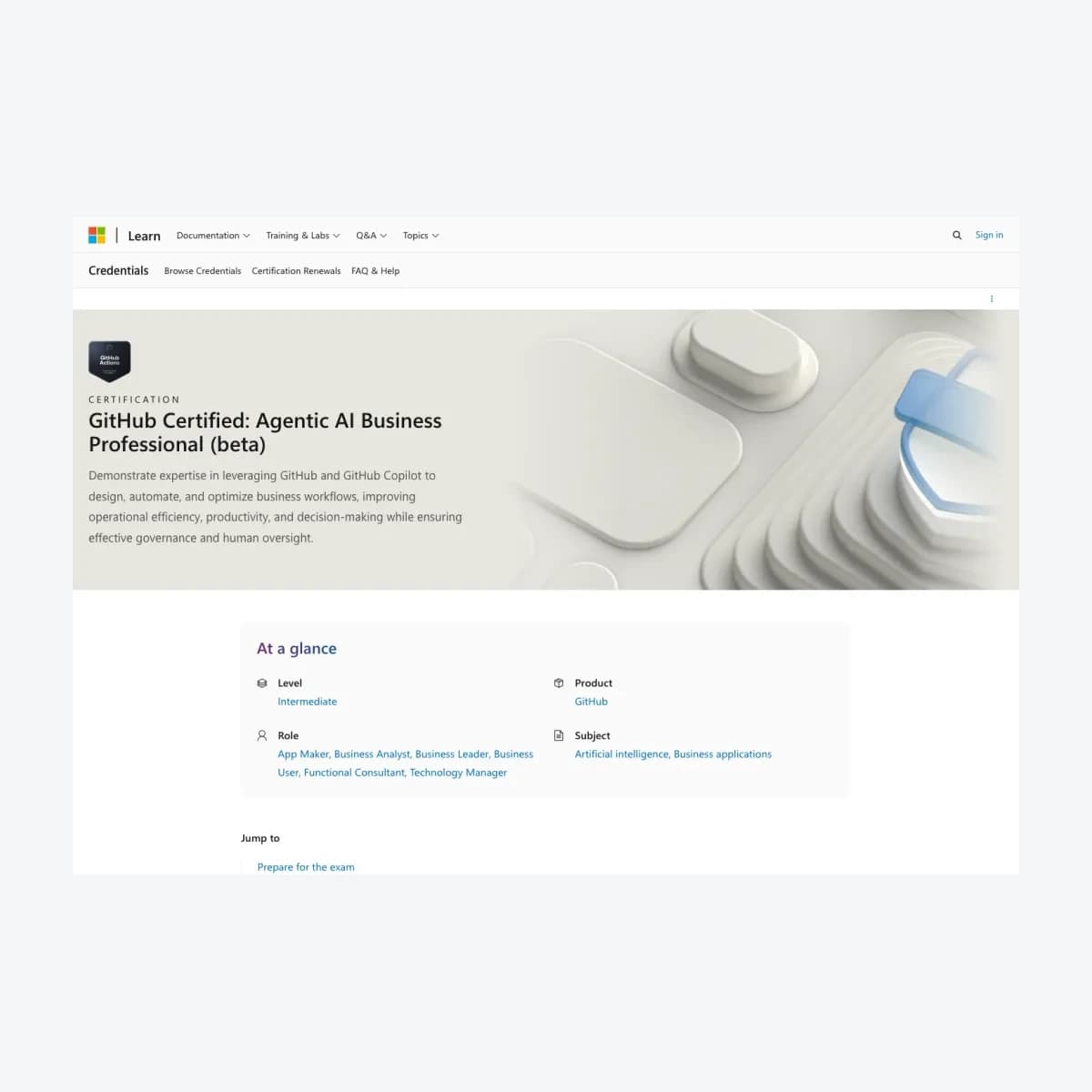
Microsoft introduced GitHub Certified: Agentic AI Business Professional on October 15, 2026, with the GH-700 exam in beta. It targets business roles using GitHub and GitHub Copilot for workflows with human oversight.
The named audience includes product and program managers, technical project managers and business analysts. The news is the dedicated credential, not a new software product.
The study guide goes beyond chat use
GH-700 covers GitHub platform use, Copilot productivity, workflow and automation design, and human-in-the-loop work. Workflow skills account for 25–30%; human oversight accounts for 20–25%.
Friday Works interprets this as emphasis on operational ownership: data inputs, tool boundaries and decisions requiring an accountable reviewer.
Why the business audience matters
Business and engineering teams need a shared description of tasks, outputs and exceptions. Automation still needs an owner when results are wrong.
A quotation assistant, for example, needs a defined data scope and approval for customer-facing output. This is Friday Works’ example, not a feature delivered by the exam.
Keep the beta status explicit
Check the certification and scheduling pages for current eligibility, languages and result handling. This report does not invent a universal price or immediate result timeline.
Friday Works recommends connecting training to an actual team workflow and evaluating subsequent operational capability.
A developing business role
The announcement points to a skills category between operations management and AI use. Fit the curriculum to the organization’s actual tools and responsibilities.
The image depicts the real Microsoft Learn credential page. Friday Works does not claim that it or its employees hold this certification.
References
Sources used in this guide
We prioritise official guidance and primary technical sources. Visit each source for full context and the latest updates.