

ContentsTap to jump to a section+
- This affects Cloudflare AI Search, not Google’s ranking algorithm.
- CJK content should use trigram; changing the tokenizer causes a full reindex.
- Evaluate each language; the CJK announcement does not establish Vietnamese quality.
A matching change for multilingual websites
Cloudflare announced on October 16, 2026 that AI Search keyword matching with the trigram tokenizer now handles Japanese, Chinese and Korean queries, including full natural-language questions. Previously, a query without spaces could be treated as a single exact phrase and often return no keyword results. Sites using AI Search should review their configuration and test queries.
This October 19 report covers an October 16 change not previously reported by Friday Works. It concerns search within a website or application, not a Google or Bing ranking change or a demonstrated increase in organic traffic.
Tokenization comes before relevant retrieval
Tokenization divides text into searchable units. Cloudflare explains that porter relies on spaces and punctuation, making it unsuitable for these languages. Its documentation recommends keyword_tokenizer: trigram under indexing_options for Japanese, Chinese and Korean content.
Friday Works considers this relevant to multilingual support and technical documentation. A failed self-service search can push users toward staff assistance, but any reduction in support demand needs measurement rather than inference from a release note.
The documentation also notes that words shorter than three characters cannot match on their own with trigram. Short product codes and abbreviations therefore need dedicated test cases, not just long natural-language questions.
Changing the tokenizer rebuilds the index
Cloudflare says changing the tokenizer triggers a full reindex: content is processed again to build searchable data. Plan for that work, especially on a large collection, instead of equating a saved configuration field with a completed migration.
Friday Works recommends recording the prior configuration, known-answer queries and index state before and after the change. Once processing finishes, check language, document version and relevance. For generated answers, inspect cited sources as well as wording.
Include spaced and unspaced questions, product names and short terms. Use approved content and preserve existing access boundaries; better matching is not an authorization mechanism.
Measure internal search separately from SEO
Friday Works suggests tracking zero-result queries, documents opened after a search and related support requests. Those measures describe internal retrieval quality. Search Console impressions and clicks describe a different path through Google Search.
The October 16 announcement does not establish the same improvement for Vietnamese. Evaluate Vietnamese and Japanese collections separately rather than assuming one shared setting improves both. Have business owners validate known answers before broad adoption.
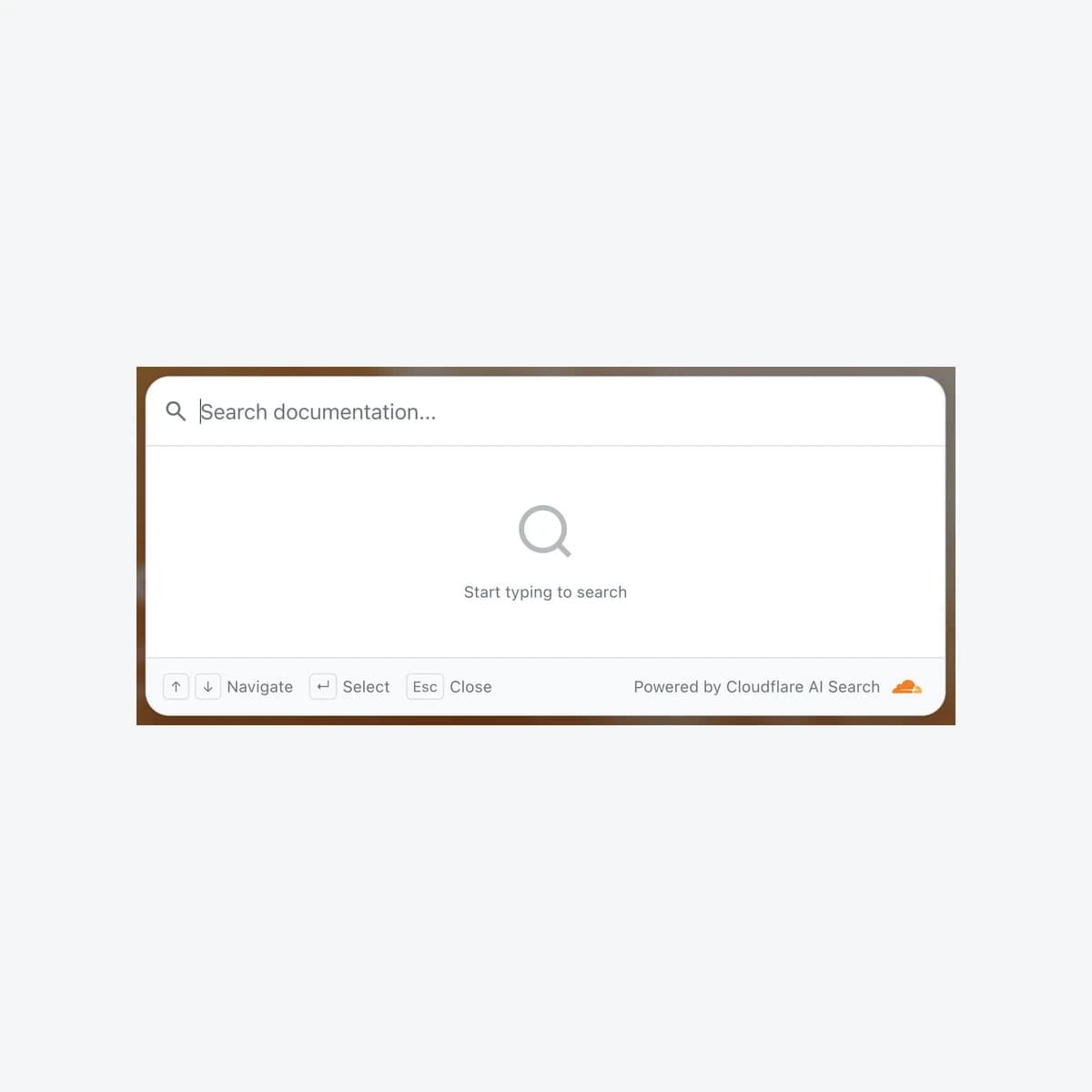
The article image is Cloudflare’s genuine embedded-search modal with an empty input. It identifies the tool but is not evidence of a successful CJK query. Friday Works has not published accuracy, latency or business-impact measurements for this update.
References
Sources used in this guide
We prioritise official guidance and primary technical sources. Visit each source for full context and the latest updates.
- CJK keyword search update — 16 October 2026Cloudflare ↗︎
- Keyword search — tokenizer, short-word limitation and full reindexCloudflare ↗︎
- Official embedded AI Search UI snippetsCloudflare ↗︎
- Official AI Search embedded-search UI screenshot; Cloudflare authors; CC BY 4.0; empty sample search, not CJK test evidence; resized and framedCloudflare ↗︎
- Cloudflare Docs full CC BY 4.0 licence retained in source archiveCloudflare ↗︎
- CC BY 4.0 licenceCreative Commons ↗︎